  |
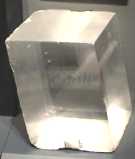
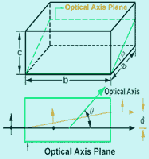
The
division of light into two components (an "ordinary" and an
"extraordinary ray") found in materials have two different
indices of refraction in different directions (i.e. when light entering
certain transparent materials, such as calcite, splits into two
beams which travel at different speeds). Birefringence is also
known as double refraction. Crystals possessing and exhibiting birefringence
include hexagonal (such as calcite), tetragonal, and trigonal crystal
classes, and are known as uniaxial. Orthorhombic, monoclinic, triclinic
exhibit three indices of refraction. They are therefore trirefringent
and are known as biaxial. Birefringent prisms include the Nicol prism,
Glan-Foucault prism, Glan-Thompson prism, and Wollaston prism.
Another material, an excellent birefringence optical crystal
undoped YVO4 is newly developed. It has very good transmission
in a wide wavelength range from visible to infrared, large index of
refractivity and birefringence difference. Compared to other important
birefringence crystals, YVO4 has higher hardness, better fabrication
property, water insoluble and man-made than calcite (CaCO3 single
crystal); easier to get large, high quality crystal and lower cost
than rutile (TiO2 single crystal). Those outstanding properties
make YVO4 very important birefringence optical material and widely used
in opto-electronic research, development and industry. For example,
the optical communication system needs a huge quantity devices of undoped
YVO4, such as fiber optical isolators, circulators, beam displacers,
Glan polarizers and other polarizing devices. |